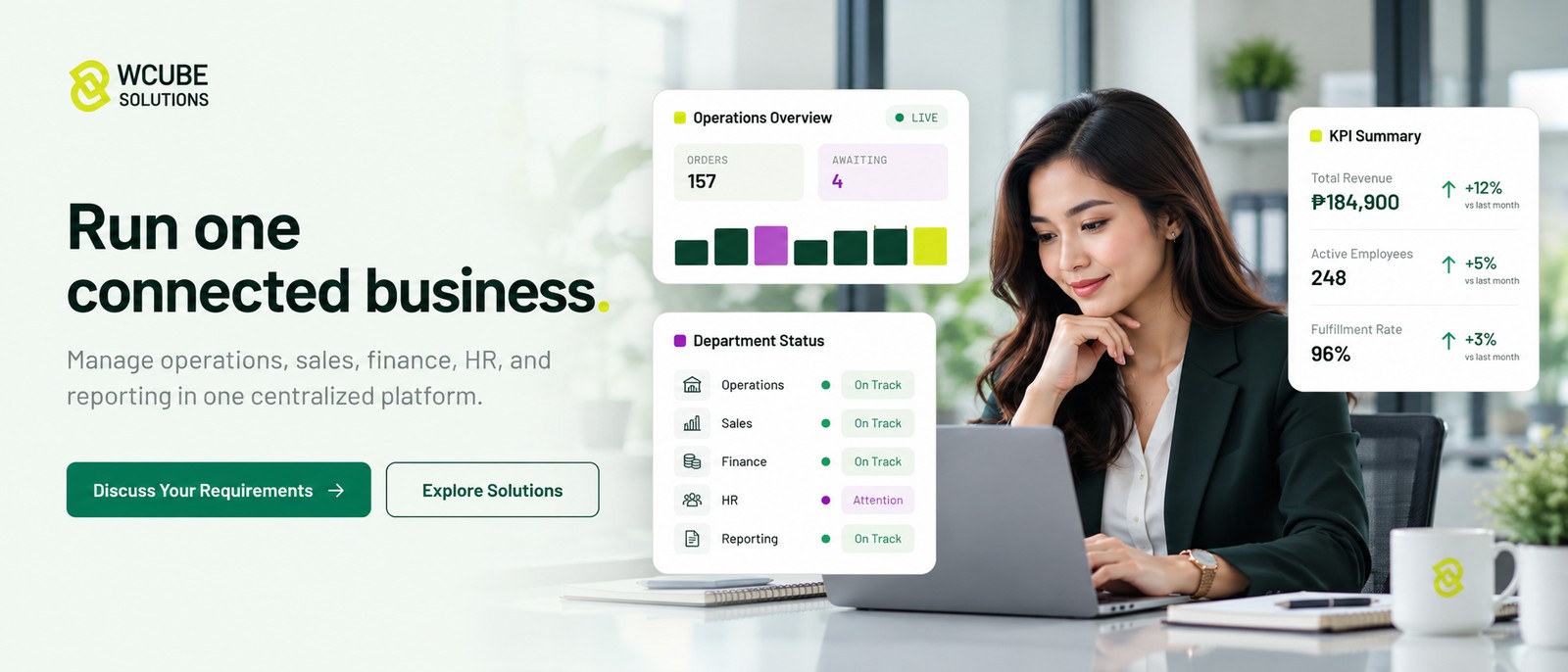
ERP & Business Management System.
One operational record from first enquiry to the ledger. Data is entered once and shared with every department that requires it.
- ERP system
- CRM
- Quote to cash
- Workflow automation
- Audit trail
Quote-to-Cash Process Coverage.
One transaction carried from enquiry to payment, with no re-entry at any departmental handoff.
Enquiry & Quotation Management.
- Enquiry captureEvery enquiry recorded against a customer, with its source and owner.
- Quotation & revisionsVersioned quotations with a full record of each change and its approver.
- Conversion trackingEnquiry-to-order conversion measured, including lost opportunities.
Order Lifecycle Management.
- Order to fulfilmentAccepted quotations convert to orders with no re-entry of line items.
- Credit and limit checksEnforced at order entry, not discovered at invoicing.
- Change controlAmendments tracked against the original order, with prior values retained.
Automated Approval Routing.
- Rule-based routingApprovers assigned automatically by value, category and department.
- Delegation & escalationApprovals are delegated or escalated when an approver is unavailable.
- Single-entry propagationOne approval updates every connected system simultaneously.
Cross-Department Data Sharing.
- Shared operational recordSales, operations, warehouse and finance work from the same record.
- Role-based accessEach team accesses only the data its role requires.
- Task ownershipCurrent owner and elapsed time visible for every open task.
Accounts & Financial Integration.
- Invoice from delivered workBilling generated from confirmed fulfilment, with no re-entry from paper.
- Accounting integrationTransactions posted through your accounting platform’s existing interface.
- Complete audit trailEvery change carries a user, a timestamp and the prior value.
The Cost of Disconnected Departments.
Manual re-entry, delayed approvals and reconciliation between systems that were never designed to align.

- Centralized Data Every department works from one database. Re-encoding between departments is eliminated.
- Workflow Automation Approvals routed automatically by rule. Requests no longer wait on who is available.
- Faster Collections Invoices generate from confirmed fulfilment. Billing no longer waits on paperwork.
- Audit Trails Every change logged with user and timestamp. Audit queries are answered directly from the record.
- Real-Time Visibility Live status across every department. Management decides on current data, not status meetings.
- Scalable Operations Transaction volume absorbed by the system. The business grows without proportional headcount.
- Process & Compliance Departmental workflows standardised with controls built in. Bottlenecks and compliance gaps are removed at source.
- Maximized Performance Documented processes and live monitoring across departments. Performance is measured, maintained and improved.
Reconciliation between systems adds cost without adding value, and that cost rises with transaction volume.
Book a Free ConsultationFrequently Asked Questions.
What is a business management system?
A business management system is software that maintains a single operational record across enquiry, quotation, order, fulfilment and invoicing. Unlike separate departmental tools, the record is entered once and shared by every department, not re-keyed at each handoff.
Is a business management system the same as an ERP?
Yes, it is an ERP system. The difference is in how it is delivered. A packaged ERP is a large, standardised platform that your company adapts to. Ours is an ERP built around how your company already operates, covering sales, operations, inventory, billing and reporting on one record.
Can it work with our existing accounting software?
Yes. Your accounting system remains in place and receives posted transactions through its own interface: REST, file exchange or direct integration, depending on the platform. Replacing the accounting system is rarely necessary.
How is a custom system different from off-the-shelf software?
Off-the-shelf software requires your team to adopt its predefined process. A custom system is built around the process you already operate. The difference matters most where that process is central to what your customers buy.
How long does implementation take?
The timeline depends on the number of departments involved and how well the current process is documented. Every project begins with a requirements assessment, which produces a schedule based on confirmed scope.