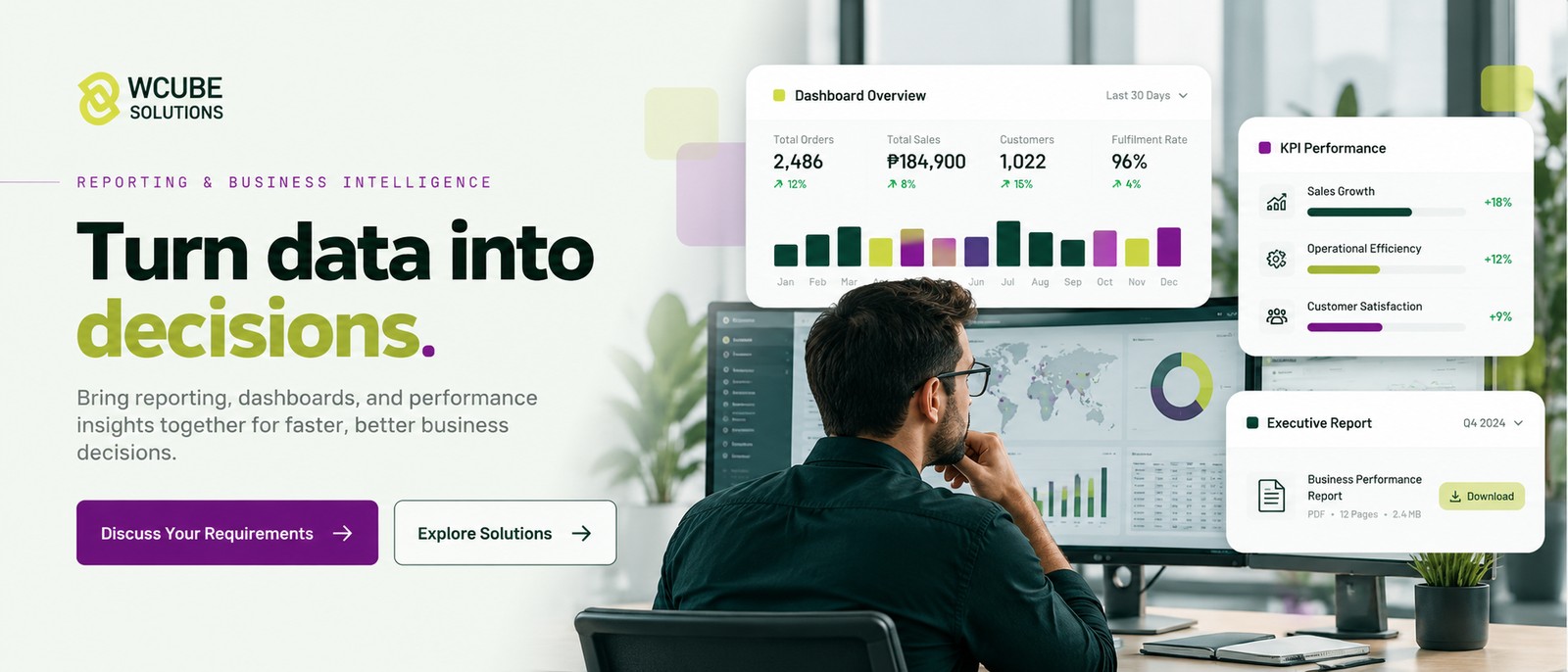
Reporting & Audit Trails.
Operational reporting on live data, with a complete change history behind every figure.
- Business reporting
- Dashboards
- Audit trail
- Real-time visibility
- Data consolidation
Operational Reporting Coverage.
Reports traceable to their source transactions and available on demand.
Field-Level Audit Logging.
- Field-level change historyUser, timestamp and prior value recorded on every edit.
- Event loggingApprovals, transmissions and system actions logged alongside data edits.
- Immutable recordsHistory is appended, never overwritten.
Cross-System Data Consolidation.
- Cross-system reportingOperations, warehouse and finance data reported on a common measure.
- Multi-site roll-upConsolidated across locations, or filtered to one.
- Scheduled refreshFigures refreshed at the interval each decision requires.
Role-Based Dashboards & Reports.
- Role-based dashboardsEach manager sees the figures relevant to their decisions.
- Scheduled distributionReports delivered on a set cycle, without manual requests.
- Drill-down to sourceEvery figure links to the records that produced it.
Audit Export & Data Retention.
- Audit-ready exportPeriod data produced on request, not reconstructed.
- Access loggingA record of who viewed and exported data, and when.
- Retention policyHistory held for the period your obligations require.
The Cost of Manually Assembled Reporting.
Days of consolidation to produce figures that are already out of date when reviewed.

- Faster Decisions Reports generated on demand from live data. Days of manual consolidation are removed.
- Centralized Data Every figure traceable to its source record. Numbers are verified, not debated.
- Audit Readiness Complete change history retained. Audits are answered from the system, not reconstructed.
- User Accountability User and timestamp recorded on every change. Who changed what, and when, is always on record.
- Demand Forecasting Consistent historical data across periods. Trends are measured, not estimated.
- Less Manual Work Spreadsheet consolidation replaced by automated reporting. Staff hours return to analysis and operations.
- Process Improvement Reporting shows exactly where a process slows down. Bottlenecks are identified from data and corrected.
- Maximized Performance Documented metrics and continuous monitoring. Performance is measured, maintained and improved.
History that was never captured cannot be recovered. Audit logging should be in place before the reporting is required.
Book a Free ConsultationFrequently Asked Questions.
What is an audit trail in a business system?
An audit trail is a permanent record of every change made to the data: who made it, when, and the previous value. Unlike a version history, it covers actions as well as edits, including approvals, exports and transmissions.
What is the difference between operational reporting and business intelligence?
Operational reporting shows current activity in enough detail to act on immediately. Business intelligence analyses longer periods to identify patterns. Operational reporting is generally the first priority, because it informs daily decisions.
Can it report across systems that do not talk to each other?
Yes. Data is drawn from each system through its own interface and aligned to a common measure. One figure can then be produced from sources that were never designed to align.
How long should audit records be retained?
Retention is determined by your regulatory and contractual obligations, not by the software. The period is set as a policy and enforced by the system. Confirm the applicable period with your accountant or legal counsel.
Do we need this if our systems already export to Excel?
Yes, where figures must be traceable. An Excel export produces a figure without the history behind it, so it cannot be traced when challenged. That traceability matters most when reporting is questioned.